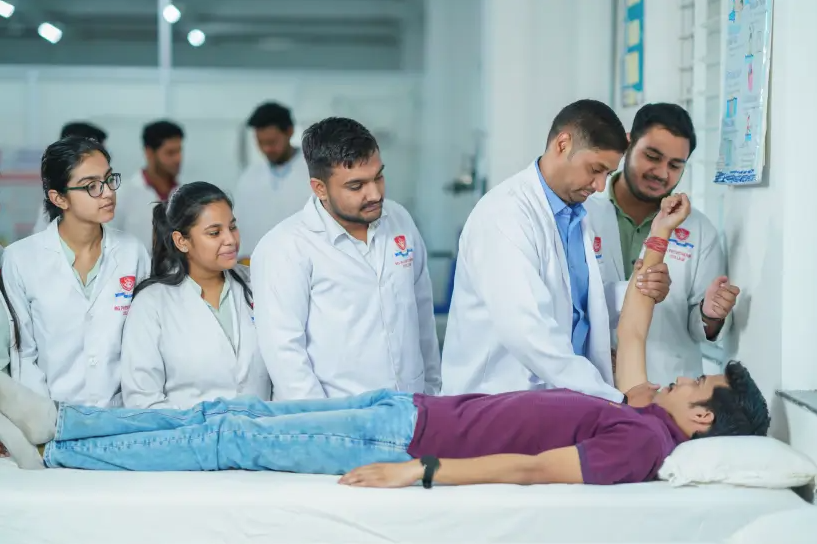
With increased awareness of healthcare in India, opting for physiotherapy as a profession is one of the best choices for any science student today. In Mahatma Gandhi University of Medical Sciences & Technology (MGUMST), Jaipur, students are given practical training with the real multi-specialty teaching hospital, where they get training from experienced doctors and physiotherapists from various departments of the hospital, like orthopaedics, neurology, sports medicine, cardiopulmonary care, etc. The physiotherapy students here are not only trained in theory but also have access to advanced facilities and excellent patient care services that are part of the curriculum. Let's take a closer look at what this career has to offer you.
Understanding the Scope of Physiotherapy in India
In the past decade, the field of physiotherapy in India has grown immensely. It has long been viewed as a support service and is now known as an integral component of care for sports injuries, post-surgical recovery, neurological disorders, and geriatric and chronic pain management. Due to the various factors mentioned above, the demand for skilled physiotherapists has surged in various settings such as hospitals, physiotherapy clinics, and rehabilitation centers.
Physiotherapists today are not an add-on to the treatment team but are seen as a key player in the team alongside orthopedic surgeons, neurologists, and sports medicine specialists. This change is what makes the future of physiotherapy in India even more promising, as avenues are expanding beyond the walls of the hospital.
Physiotherapy Course Details Worth Knowing
Before enrollment, students are interested in the details of a physiotherapy course. This is the normal route and will take about 4 years and 6 months, leading to a Bachelor of Physiotherapy (BPT) degree, which will have the following components:
The study of the structure and function of the body is known as anatomy, physiology, and biomechanics.
- Anatomy, physiology, and biomechanics are the foundation subjects.
- The core physiotherapy training involves the use of "electrotherapy," “exercise therapy," and “manual therapy" techniques.
- Clinical postings - supervised practice in orthopaedics, neurology, paediatrics, and cardiopulmonary units
- The mandatory internship is an essential part of the program where students will gain practical experience in a hospital setting before graduation.
After BPT, students can opt for a Master of Physiotherapy (MPT) to get specialisation in the field and hence in-depth career growth with better salary packages. This clinical exposure begins early in the curriculum and is self-confidence-building, as seen at institutions like MGUMST, which have an attached teaching hospital.
Physiotherapist Salary in India: What to Expect
One of the most frequently asked queries by aspirants is related to the physiotherapist salary in India, and there's a reason for it - they vary depending on experience, specialization, and the place of work. A hospital or clinic physiotherapist will earn a fairly basic but consistent salary that increases with experience and further qualifications.
Once the physiotherapist specializes and gets into a niche where there is more demand, such as sports rehabilitation, neuro-physiotherapy, orthopedic rehabilitation, etc., the pay skyrockets. Other physiotherapists, such as those who work in sports teams, corporate wellness programs, or run their own clinic, tend to make more money than those in conventional hospital positions. The government hospitals also have a fixed salary structure and job security, which makes them a popular option among many graduates.
Location is also part of the factor - those physiotherapists who work in metro cities and established healthcare hubs generally make higher incomes, of course, except for those in private practice who have extensive experience in the field.
Exploring Physiotherapy Career Options
Modern physiotherapy creates so many doors today, which many students are unaware of. The following are some of the most common physiotherapy career paths:
1. Hospital practice - working with orthopedic, neuro, and ICU rehab units
2. Sports physiotherapy - treating athletes, working with sports schools or teams
3. After a certain level of experience, a medical practitioner may choose to have his or her own practice, which is known as a private clinic.
4. Teaching in physiotherapy colleges or involvement in clinical research is another type of career that can be considered.
5. Companies are increasingly investing in employee wellness programs, a trend that is expected to continue in the years ahead.
6. Home healthcare - Particularly relevant for elderly or post-surgical patients who would like to recover at home.
This degree of flexibility allows students to see themselves going from clinical practice to teaching to specialized care as they get older.
Physiotherapy Specializations Gaining Popularity
As the field matures, physiotherapy specializations are becoming more defined and in-demand.
- Neuro-physiotherapy - rehabilitation for stroke, spinal cord injuries, and neurological disorders.
- Sports physiotherapy is about injury prevention and recovery for athletes.
- Cardiopulmonary physiotherapy - helping recovery from heart and lung disease.
- Child Physiotherapy - working with children on developmental and mobility problems.
- Geriatric physiotherapy helps address issues of mobility and pain that occur with aging.
The early selection of a specialization and training in a hospital that has a large group of specialists in several of these fields will be a real plus for the student when he/she begins applying for employment or pursuing further studies.
The Future of Physiotherapy in India
The future of physiotherapy in India is closely linked with the evolution of the healthcare system in India. As more hospitals invest in dedicated rehabilitation units, physiotherapy treatment is becoming more and more covered by insurance, and awareness is rising on the importance of injury prevention; the profession is only expected to get more and more recognized and in demand.
The field is also being transformed by technology, such as wearable technology that monitors recovery progress and tele-rehabilitation programs for patients who aren't able to make it into the office. In the future, as the physiotherapy profession in India develops and becomes more specialized and respected, physiotherapists who are up-to-date with these tools and have a good grasp of the clinical fundamentals will be able to keep up.
Why Practical Exposure Matters
There is nothing like hands-on clinical experience to complement classroom education. Students who have trained at hospitals with advanced facilities, experienced doctors, and actual patients will leave with much more confidence than those undergoing training in just simulated hospitals. The knowledge of assessing patients, modifying treatment, and communicating with specialists from other departments is something that can only be acquired by observing these things by experienced physiotherapists.
Hence, it is so important to select the right institution as much as it is important to choose the right career. A college affiliated with a running multi-specialty hospital provides the students with regular and diverse cases ranging from sports injuries to post-operative treatment and rehabilitation from the initial semesters of the college.
The Bottom Line
Physiotherapy is a healthcare profession that offers diverse career pathways across clinical practice, rehabilitation, sports, education, and research. The journey has its share of flexibility and choices, and from different career paths to the potential payoffs with experience, it's a path of stability and purpose.
If you are serious and want to build your career with solid clinical skills, Mahatma Gandhi University of Medical Sciences & Technology (MGUMST) offers the right kind of exposure to a real hospital environment, experienced faculty, and advanced facilities, which enable you to turn classroom learning into real clinical skills.