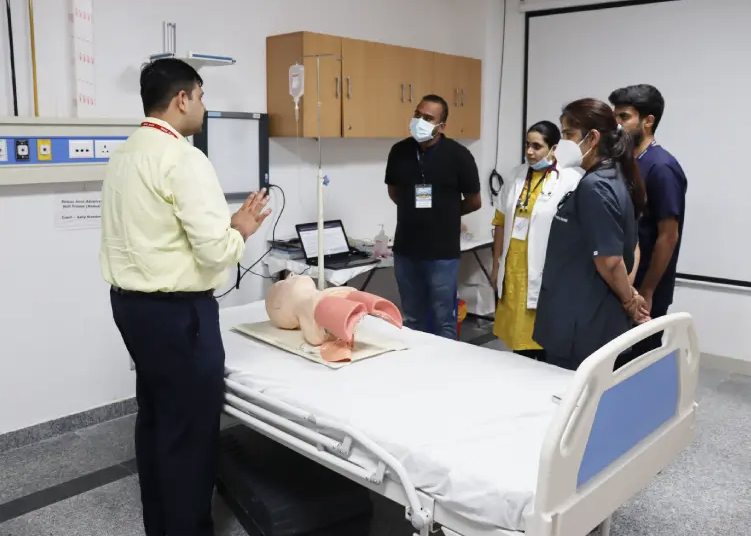
Being a student of MBBS is a step that most of the students can never forget, and knowing about the life of the medical college beforehand makes it easier to jump. In the first year of MBBS at Mahatma Gandhi University of Medical Sciences & Technology (MGUMST), Jaipur, students begin their medical education within a university campus supported by medical teaching facilities, laboratories, and a teaching hospital. Let's take a look at what the first year will really be like.
The MBBS First Year Subjects You'll Meet
MBBS 1st-year subjects are the foundation of all subjects. Acknowledge that you will experience your days with:
Anatomy - Dissections, bone boxes, and an endless number of diagrams, making the human body feel familiar instead of foreign.
Physiology - Understanding the function of organs and systems through labs, practicals, and viva.
Biochemistry - Molecular logic of health/disease, acquired through reactions and lab work.
The first phase also includes a Foundation Course, Introduction to Community Medicine, Humanities, professional development through AETCOM, and Early Clinical Exposure, which introduce you to hospital exposure early on. If you know the syllabus of your first year of MBBS before you start studying, then you can plan how to spend your time rather than scramble around before the exams.
A Typical Day: Life of an MBBS Student
If you ask any senior what an MBBS student's life is like, you'll get the same rhythm: Early mornings, back-to-back lectures, practicals in the afternoon, and then library sessions followed by relaxation in the evening. A day in the life of a medical student is never a glamorous one - dissection notes before breakfast, physiology practicals after lunch, and revision till the lights go off in the hostel. But this process is the very thing that is the foundation of discipline, which every doctor will have to go through at some point.
MGUMST's MBBS curriculum includes Early Clinical Exposure in the first phase, helping students understand how basic medical sciences relate to patient care and clinical practice. Early clinical exposure gives first-year students opportunities to connect basic-science learning with patient care and clinical skills. Observing experienced doctors in practice, how departments work, and observing early to get an idea of what is going on is an advantage that textbooks can't provide.
How Is Life in Medical College, Really?
As an aspiring medical student, you must be wondering what life in medical college is like, and the straight response is intense but transformative. The workload is greater than that of a school or general undergraduate course, and the competition is intense, as you are studying with some of the sharpest minds who have cleared NEET. Medical college, however, has a support system that you would never otherwise have: fellow students who share notes, professors who can remember your name, and classmates who remain lifelong friends thanks to shared terror of an anatomy viva.
Time management is your superpower. Weeks one through three are a balancing act between lectures, dissections, self-study, and social life - by month three, most students are back on the rhythm.
Medical College Hostel Life
This is also for most of the first-year students; the first time that they are away from home, and the medical college hostel life has a significant influence on their experience. Before exams, before late-night studying Newton's second law of motion, or joining a table of strangers around a meal, hostels serve as extended classrooms. Independence also means responsibility: managing your schedule, laundry, and meals without a reminder from your parents and your studies.
Having a well-maintained hostel with a good Wi-Fi connection, a mess, and a good location in the academic block (such as MGUMST) makes it much easier to get used to the new independence.
MBBS Student Life in India: The Bigger Picture
The five-and-a-half-year program of MBBS in India is a rigorous yet fulfilling course, featuring continuous evaluations, rotations, and clinical experiences, along with a structured syllabus. The good thing is the purpose it serves - a late night spent memorizing the origin of the quadriceps or the biochemical steps in a reaction to recognize it when it's on paper is a step towards being someone who can really help people.
Medical colleges affiliated with hospitals provide an opportunity for the students to experience patient care at an early stage, as the hospitals have specialty departments and advanced facilities. The exposure to a variety of medical cases, ranging from general medicine to specialised departments, is a way of fostering clinical thinking long before the end of the final year.
MBBS First Year Experience: What Actually Changes You
Your first year of MBBS is not only academic! It's a first cadaver dissection, a first time in a white coat, and a first time talking to a concerned family member during a hospital visit while explaining a diagnosis concept. It's learning how to deal with stress, how to do well on a test, and how to cope with high-level syllabi, but also learning about real excitement in the workings of the human body.
Universities with well-trained doctors in faculty and advanced patient care facilities on campus, like the teaching hospital of MGUMST, provide students with a hands-on advantage. First-years learn concepts in context rather than separated from practical application and develop confidence that is much quicker than a lecture-based approach.
Making the Most of Your First Year
There are a few things that can help ease the transition:
- Get into a study plan early, rather than waiting until exams to review.
- Be active and observe, ask questions, and relate textbook concepts to cases.
- Support each other in your hostel community - group study and shared experiences help to make a heavy syllabus easier.
- Look after your body and your mind: Balance or burnout is a common occurrence.
Conclusion
This first year of MBBS is challenging and yet is the base on which your medical career rests. Whether you're learning basic subjects or getting experience with living in a hostel or the actual clinical work, all of this year is influencing the doctor you will eventually become. Mahatma Gandhi University of Medical Sciences & Technology (MGUMST) provides a conducive atmosphere for MBBS students, where academic learning and hands-on experience in the medical field intertwine, ensuring a strong and confident start to their medical careers.