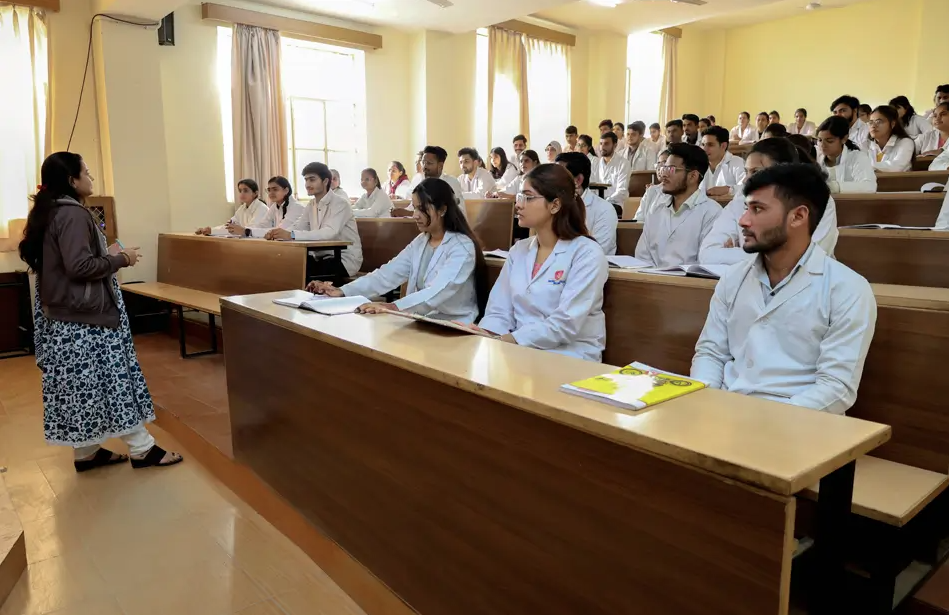
One of the major reasons why students choose Mahatma Gandhi University of Medical Sciences & Technology (MGUMST), Jaipur, for their medical education is its teaching hospital. Located within MGUMST's 45+ acre university campus, Mahatma Gandhi Hospital is a multispecialty teaching hospital providing tertiary healthcare and clinical training. It has a large pool of experienced doctors, modern diagnostic and treatment facilities, and a wide range of medical specialties, including cardiology, neurology, orthopaedics, oncology, and more.
For students, it's learning that doesn't end in the books; it extends to the bedside, to the OT, to one patient's department, and to the other, every day. Let's take a closer look at the elements that make this a teaching hospital so much a part of the MGUMST experience.
Why a Teaching Hospital Changes Everything
Try asking a physician how he or she actually acquired medical knowledge, and most will tell you that it was in a hospital, not in a lecture hall. When students can actually see patients, and witness symptoms, and watch decisions being made, and be supervised by a medical teaching hospital in Jaipur, as happens at Mahatma Gandhi Hospital, this is something no classroom can do.
The key distinction between a medical college and a medical college hospital in Jaipur is that instead of merely hearing the presentation of a disease, students have the opportunity to see it, discuss it during rounds, and eventually manage it themselves with the help of senior faculty. Here, theory and practice intertwine in a manner that fosters true clinical confidence, rather than mere test-taking readiness.
Medical Specialties Under One Roof
What makes this hospital so tremendous is the quantity of specialties to choose from for students to learn about. Departments span:
- General Medicine and Surgery is the basic clinical course that every MBBS student gets to learn, as it is the foundation of each and every clinical course of study.
- Cardiology and Cardiothoracic Surgery - The complex treatment of heart diseases using advanced diagnostics.
- Neurology & Neurosurgery - from stroke management to spinal surgery.
- The orthopaedics unit includes trauma care, joint replacements, and sports injury management. The orthopaedics unit involves trauma care, joint replacements, and sports injury management.
- Paediatrics and Obstetrics-Gynaecology - All aspects of child and maternal health care.
- Cancer diagnosis and multidisciplinary treatment planning (oncology).
- Emergency Medicine - Speed and urgency in learning about critical care.
It is also a multi-specialty hospital, and during training, students rotate through almost all the major specialties, gaining broad-based clinical exposure and knowledge, rather than limited subject-specific knowledge.
Learning from Experienced Doctors
The textbooks tell you about the conditions; the experienced doctors tell you about the patients. The faculty members at the MGUMST Teaching Hospital are not just academics but practicing clinicians as well who attend to patients every day, conduct surgeries, and handle complex cases in addition to teaching. A dual role provides students with teachers who are learning and practicing the very concepts they are being taught.
Students observe experienced doctors on ward rounds, in case discussions, and on OT postings on how they approach the diagnosis, consider treatment options, and communicate with patients and families. These opportunities for observation often have more impact than lectures on how future doctors will ultimately practice medicine.
Advanced Facilities That Support Real Learning
The quality of a teaching hospital is determined by the kind of instruments that it gives to its students. Mahatma Gandhi Hospital has an advanced infrastructure of diagnostic and treatment facilities like modern imaging technology, well-equipped operation theatres, ICUs, and specialized labs. It is of very significant importance for the students, as they will be familiar with the tools used during their training periods when they are already talking about their careers.
The hospital has received JCI accreditation and NABH accreditation, while its medical laboratory has received NABL accreditation. This means that the students get to undergo training in an environment where they are exposed to procedures and sanitation standards as they would be at any top-notch hospital after graduation.
Patient Care Services as a Teaching Tool
This case study demonstrates the use of patient care services as a teaching tool.
The hallmark of a teaching hospital is that patient care becomes a part of the curriculum. Each patient encounter, whether it's history taking, a procedure explanation, or follow-up after treatment, is an on-the-spot class in empathy, communication, and clinical reasoning.
In MGUMST, students are able to see and slowly get involved in patient care in the various departments, not only treating the disease but also treating the patient. This encompasses sensitivity to patient fears, ability to communicate disease diagnosis in meaningful terms, and ability to communicate with other specialties, soft skills that are as important as the clinical information and are not usually addressed solely in lectures.
A Hub for Medical Education in Jaipur
MGUMST is a private medical university established in Rajasthan. With its strong presence in Jaipur, it has become a significant institution for medical studies in the city. The teaching hospital is not an add-on to the college: it is a component of the learning experience from the first year onwards. MGUMST's MBBS curriculum includes Early Clinical Exposure, allowing students to begin connecting basic-science learning with patient care from the first year.
This integration is one of the reasons this institution has become a reputed medical college in Jaipur and attracts students from all over India seeking practical training in medicine instead of the classroom setting.
What Makes It Stand Out Among Teaching Hospitals in Jaipur
What MGUMST's Teaching Hospital Offers Medical Students is its size and scope. Hundreds of beds, a broad specialty mix, and patient volume provide students with exposure to a truly varied case mix, from common to rare and complex conditions. That's a crucial variety, and a student who's come across only textbook cases will have a lot more trouble in real practice than one who's seen the unpredictability of real patient care.
It is also the truest hospital for medical students - every department, every ward round, and every consultation is planned with a teaching goal in mind, and students are not passive observers; they are active participants in the learning process.
Bridging Classroom and Clinic
The real value of a teaching hospital lies in how seamlessly it connects what students learn in lectures to what they see in patients. A concept read in a physiology textbook becomes clearer the moment it's observed in a patient's symptoms. A pharmacology lesson on drug interactions becomes memorable when seen applied in an actual treatment plan. This continuous loop between classroom and clinic is what ultimately shapes confident, competent doctors - not memorization, but repeated real-world application.
Conclusion
A hospital that teaches and a college that treats - that's the model driving medical education forward, and it's precisely what students experience at Mahatma Gandhi Hospital. With a wide range of medical specialties, experienced doctors, advanced facilities, and patient-centered training built into every year of study, the journey from classroom to clinic feels natural rather than daunting.
For students seeking a genuine, hands-on medical education, Mahatma Gandhi University of Medical Sciences & Technology (MGUMST) offers exactly the kind of teaching hospital experience that shapes not just good students but also capable, confident future doctors.