Healthcare has changed a lot from the time when hands-on bedside care and predictable clinical duties were the norm. Today's hospitals face increasingly complicated diseases, new technologies and patients with a variety of physical and emotional needs. In this context, nurses are no longer passive agents of therapeutic strategies. They evaluate changing situations, work with interdisciplinary teams, teach families, and react quickly when unexpected problems occur.
Certainly, a clear understanding of medical knowledge is the foundation of nursing practice. But just knowing is not enough to prepare experts for every eventuality that happens inside a busy hospital. Patient-centred care has steadily emerged as the defining premise of quality healthcare across the world. Each patient has unique concerns, expectations and emotional challenges in addition to their medical conditions.
Therefore, nurses need to provide correct professional care as well as communicate sensitively and gain the confidence of patients. Clinical competence informs treatment decisions and empathy with good judgement enhances the overall healing experience. That means hospitals are looking for more and more graduates who have a scientific grasp in addition to emotional intelligence and professional maturity. Interestingly, this shifting expectation is in support of global healthcare trends.
The World Health Organization estimates:
- ●Approximately 29 million nurses in the world today
- ●The sector could still be short 4.5 million nurses by 2030.
Source: https://www.who.int/news-room/fact-sheets/detail/nursing-and-midwifery?
What Skills Do Hospitals Expect from Nursing Graduates Today?
Today’s hospitals want nursing graduates who can boldly go beyond the general clinical obligations and mandated medical procedures. Medical knowledge is definitely the backbone of professional nursing practice, but employers want much more. Compassion, tolerance, thoughtful communication and unshakable professional ethics under difficult circumstances are required in every patient interaction.
Nurses often become the soothing voice when uncertainty shrouds frightened patients and worried family members. They notice little bodily changes, read clinical indicators and provide timely information without unneeded misunderstanding. “Calm decision-making under increased pressure often transforms challenging situations into well-managed clinical outcomes.
Hospitals also respect personnel who work in sync with doctors, therapists and interdisciplinary healthcare teams on a daily basis. This type of collaboration improves patient safety and helps to prevent unnecessary confusion on a difficult trip through treatment. The best nurses are also flexible since healthcare settings rarely go as planned.
Communication
Imagine an old patient leaving the hospital with so many uncertainties. Medicines at various times can be complex and the directions daunting. The nurse sees the hesitancy and sits calmly alongside the patient. She explains every medicine in simple words and answers every query patiently. Meanwhile, the anxious family begins to relax. Thus, true trust comes from more than therapeutic expertise.
Empathy
A young patient discreetly avoids physiotherapy following painful surgery. The nurse asks what's scary instead of insisting. Secret anxieties and discomfort are revealed by the sufferer. In the meantime, the nurse comforts and encourages. Thus, the patient begins therapy with increased confidence. Hence, small moments of awareness lead to substantial healing.
Critical Thinking
One nurse finds her busy emergency room suddenly in a strange way. She sees a patient’s respiration becoming shallow, despite stable monitors. She can tell something is awry and calls the doctor right away. Minutes thereafter, the patient deteriorates fast. Where she relied on her judgement instead of assumptions, treatment starts without delay. So, critical thinking matters more than anything else at this juncture.
Leadership and Teamwork
No practitioner works in isolation when a patient requires urgent attention. The doctors decide on the treatment and the nurses monitor the changing condition and provide timely information. In contrast, technicians do not waste time in making an appropriate diagnosis. Pharmacists review all recommended medicines before administration, ensuring diligence. Everyone brings distinct knowledge, yet every choice is in favour of one shared purpose.
How Clinical Training Builds Confident Nurses
The classroom gives you a strong intellectual base, but real confidence comes with getting practical experiences. There is a world of difference between reading about patient care and giving it at the bedside in a hospital. It is exactly for this reason that structured clinical training is an integral aspect of nursing education.
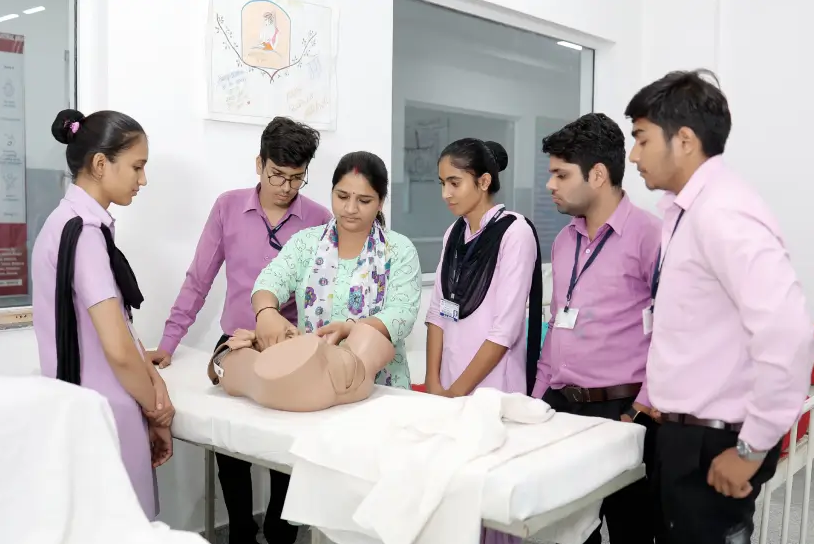
Students first develop their abilities in simulation facilities where realistic settings allow them to practice procedures without risk to patient safety. Supervised hospital postings expose them to real clinical contexts as they gain confidence. Here, they interact with patients, watch experienced healthcare workers and gradually learn how to respond with confidence and compassion. They also watch:
- How emergencies develop
- How interdisciplinary teams collaborate, and
- How prompt decisions influence recovery.
This experience makes the transition from the classroom to professional practice easier and gives it much more purpose.
What Makes MGUMST Different for Nursing Education?
The learning environment is as important to the quality of nursing education as the curriculum. That’s where MGUMST has a distinct approach. The university gradually introduces students to actual healthcare environments so that learning does not merely take place in classrooms, and so that theory starts to make practical sense.
Here are the Key Differentiators That Set MGUMST Apart:
Affiliated Teaching Hospital Offering Continuous Bedside Clinical Exposure
Nursing education is considerably more relevant when classroom learning is reinforced with real patient care. This is exactly where MGUMST is different. Students have experience in active clinical settings from an early level of healthcare with affiliation to Mahatma Gandhi Hospital and Sri Ram Cancer & Super Specialty Center. Gradually, theoretical ideas turn into practical abilities and the confidence that future nursing professionals are expected to have, as students observe experts, work with diverse teams and undertake supervised training.
Exposure to a High Patient Footfall across Diverse Cases
Clinical competence is learned progressively and classroom teaching can never substitute for the experience of working around real patients. This is why the learning environment is as important as the curriculum itself. The students at MGUMST receive their training at Mahatma Gandhi Hospital, the largest private hospital in Rajasthan, with around 1,450 beds. The hospital exposes students to various medical issues and treatment approaches across specialties. Their learning becomes more practical as students see experienced physicians, work with patients and participate in supervised care. Their clinical judgment improves with every significant learning experience, taking professional confidence to the next level.
Rotations through Major Clinical Departments for Multidisciplinary Learning
Nursing students gain more confidence by seeing the realities of healthcare in several medical specialties rather than remaining in one clinical setting. This is exactly why MGUMST promotes multidisciplinary learning through its teaching hospitals. Students rotate through a number of areas and learn how different professionals collaborate to provide coordinated patient care. This wider viewpoint not only improves their clinical judgment, but also enables them to respond more attentively to different patient requirements. Key clinical departments include the following:
- General Medicine
- General Surgery
- Pediatrics
- Obstetrics & Gynecology
- Orthopedics
- Emergency Medicine
- Oncology
- Cardiology
- Neurology
- Anesthesia
- Dermatology
- ENT
- Nephrology, and
- Gastroenterology.
Advanced Simulation Labs Supporting Safe, Hands-on Skill Development
Nursing students always need a safe place not only to practice but also to get better at their skills before they start working with patients in a hospital. In these situations, learning through simulations is very helpful. Students at MGUMST learn in clinical skill labs that have mannequin-based simulations, Basic Life Support (BLS) training, computer-assisted learning (CAL), and other specialized lab equipment.
They can learn important clinical skills during these sessions before starting their supervised hospital postings. So, when they care for real patients, they do so with more confidence, better preparation, and a better understanding of how clinical methods work.
Research-focused Academic Environment Encouraging Innovation
MGUMST provides its students with a Central Research Laboratory, Clinical Trial Center, and high-tech equipment for molecular diagnostics, genetics, and clinical studies. The university also performs approved clinical trials and promotes collaborative research across the healthcare fields. As students participate in this research-oriented ecosystem, they slowly begin to develop scientific curiosity, evidence-based thinking, and a better appreciation of how medical information moves forward beyond the classroom.
Recognised Accreditations Reflecting Quality Education and Healthcare
For students, the day-to-day standards of a healthcare facility are often a major factor in their decision-making, because those standards impact both the education students receive and the care they give to patients. This is precisely why institutional accreditations have meaning. MGUMST trains students in an environment where quality and accountability are integrated in clinical practice.
Mahatma Gandhi Medical College & Hospital is the first academic medical center in India to get accredited by the Joint Commission International (JCI). The hospital is also accredited by NABH, NABH Nursing Excellence, NABL for its Central Laboratory, ISO 9001:2015, and its Blood Center. Such learning immerses students into established clinical protocols, quality-oriented health care systems and professional practices that prepare them effectively for the duties of contemporary nursing.
Is B.Sc. Nursing a Good Career in India?
The healthcare sector is growing by leaps and bounds, and many new opportunities are available for competent nursing professionals in a variety of medical settings. With hospitals getting larger and more specialized healthcare available to more people, the demand for trained nurses keeps growing.
This is exactly why a B.Sc. Nursing degree is much more than a job after graduation. Students might have fulfilling employment in government hospitals, private healthcare facilities, community health services and specialised clinical departments.
Those interested in academics or advanced practices may choose higher education options including M.Sc. Nursing and research programs. Many graduates often pursue foreign prospects after acquiring the required license requirements in their chosen destination.
The Closing Note
Finding a college where information becomes professional confidence is the key. From the very beginning, MGUMST students combine academics with clinical experience. Professional instructors stimulate critical thinking, while contemporary labs, a well-equipped campus, and hospitals teach students how healthcare works.
Those interested can explore the admission process, meet the faculty, get more information on the Nursing Department, tour the campus, learn about the clinical training setting at the teaching hospital and check the university's placement support prior to applying to make an informed decision.
If MGUMST is on your mind, check out the B.Sc. Nursing program, find out about clinical training options and get in touch with the admissions team to ask questions or talk through the admissions process. The better educated your selection is today, the better foundation your rewarding nursing profession will be tomorrow.
FAQs
Is B.Sc. Nursing a good career in India?
Yes. B.Sc. Nursing is a good career in India. This program offers strong career prospects in the following areas:
- ●Government hospitals
- ●Private healthcare
- ●Community health
- ●Research
- ●Higher education, and
- ●Overseas healthcare systems.
Which skills are most important for nurses?
Successful nurses combine clinical knowledge with communication, empathy, critical thinking, teamwork, leadership, ethical decision-making, and the ability to stay calm under pressure.
How does clinical training prepare nursing students?
Clinical training helps students apply classroom knowledge through simulation labs, supervised hospital postings, patient interactions, and real-world healthcare experiences.
Why is communication important in nursing?
Clear communication helps nurses explain treatments, reduce patient anxiety, coordinate with healthcare teams, prevent misunderstandings, and improve overall patient care.
What should I look for in a B.Sc. Nursing college?
Choose a college with experienced faculty, teaching hospitals, simulation laboratories, clinical exposure, research opportunities, modern infrastructure, and good placement support.
Does MGUMST provide practical clinical training?
Yes. MGUMST combines simulation-based learning with supervised hospital postings, allowing students to gain practical experience before beginning professional nursing practice.
Can B.Sc. Nursing graduates pursue higher studies?
Yes. Graduates can pursue M.Sc. Nursing, postgraduate specialisations, research programmes, and various certification courses to expand their career opportunities.