Skin is the one organ everyone can see, which is exactly why dermatology has quietly become one of the most sought-after specializations in Indian medicine. It sits at a rare intersection: genuine medical complexity, strong earning potential, and a manageable lifestyle compared to many other specialties. If you're considering this path, here's a clear, honest look at the courses, costs, skills, and career reality behind becoming a dermatologist.
What Is a Dermatology Course?
An integrated course in dermatology is a specialized medical course that concentrates on the medical diagnosis and therapy of skin, hair, nails, and connected tissue disorders, from acne and eczema to autoimmune skin problems or cosmetic procedures. This can be an MD in dermatology after MBBS, a diploma course, or shorter certificate courses focused on developing particular skills, such as laser therapy or aesthetic procedures.
Dermatology Courses After 12th
Unlike what many students think, one cannot directly go for dermatology courses after 12th. Dermatology is a postgraduate medical course, which means that after 12th grade, you should go for an MBBS course first. The first steps after 12th grade are the most basic ones, which include NEET-UG, MBBS, and NEET-PG for MD dermatology. Some students also consider BHMS or BAMS as an alternate option to enter into some skin-related specializations, which are covered below.
Dermatology Courses After MBBS
After completion of MBBS, the general pathway is getting into MD (Dermatology, Venereology, and Leprosy) through NEET-PG, which has a duration of 3 years. The alternatives are a Diploma in Dermatology (DDVL), a shorter two-year course at some institutions, or a Diplomate of the National Board (DNB) in Dermatology, which is equivalent in recognition to the MD course. There are also a variety of additional fellowship programs and cosmetology, laser, and aesthetic medicine certificate courses that are widely available following the core postgraduate qualification for those interested in cosmetic/aesthetic medicine.
Dermatology Course After BHMS
Students coming from a BHMS (Bachelor of Homeopathic Medicine and Surgery) background can also specialize in skin-related treatment, typically through an MD in Homeopathy (Repertory or Materia Medica with a skin-disease focus) or through dedicated certificate and fellowship programs in dermatology tailored for homeopathic practitioners. It's worth noting that the scope of practice differs meaningfully from an MBBS-MD dermatology pathway since homeopathic dermatology follows a different diagnostic and treatment framework altogether, so the choice really depends on which system of medicine you want to practice within.
Dermatology Course Fees
Dermatology course fees vary widely by institution type and program level. Government medical colleges (MD Dermatology) typically charge ₹10,000 to ₹100,000 per year, the most affordable route, provided you clear the NEET-PG cutoff. Private medical colleges/deemed universities usually range from ₹15 lakhs to ₹40 lakhs or more for the full three-year MD program. A Diploma in Dermatology (DDVL) generally costs less than a full MD, though private institution fees can still run into several lakhs, and certificate/fellowship courses in cosmetology, laser, or aesthetics typically range from ₹50,000 to a few lakhs, depending on depth and duration.
Is Dermatology a Good Career?
For most who enter it, yes, and for fairly concrete reasons. Dermatology offers a strong combination of intellectual variety (medical, surgical, and cosmetic work all within one specialty), comparatively predictable working hours versus specialties like general surgery or emergency medicine, and a growing market driven by rising skincare awareness, an aging population, and booming demand for aesthetic procedures. The trade-off is that entry is competitive: NEET-PG seats in dermatology are among the most sought-after and hardest to secure, so realistic planning around backup options matters.
Dermatologist Salary in India
Experienced dermatologists with established private practices and aesthetic clinics may earn substantially more than salaried hospital consultants, with income varying widely depending on location, reputation, patient volume, and services offered.
Government sector salaries are more uniform but often come without the insecurity or lack of pension benefits that private practice does.
How to Become a Dermatologist in India
The complete path to becoming a dermatologist in India runs through five steps: clearing NEET-UG after 12th with PCB; completing MBBS (5.5 years including internship); clearing NEET-PG for postgraduate admission; completing an MD in Dermatology, Venereology, and Leprosy (3 years) or an equivalent DNB/diploma; and optionally pursuing fellowships in cosmetology, laser treatment, or pediatric dermatology for further specialization. It's a long runway, typically 8 to 9 years post-12th, but it leads to one of the more flexible and financially rewarding specializations in medicine.
Where to Train: MGUMST's Dermatology Program
For MBBS graduates evaluating where to pursue this specialization, it helps to see how an actual university structures its training.
Mahatma Gandhi University of Medical Sciences and Technology (MGUMST) in Jaipur, verified directly from its official website, runs an MD in Dermatology, Venereology, and Leprosy as a three-year postgraduate program under its dedicated Department of Dermatology, Venereology, and Leprosy (DVL), which currently admits an annual intake of eight candidates.
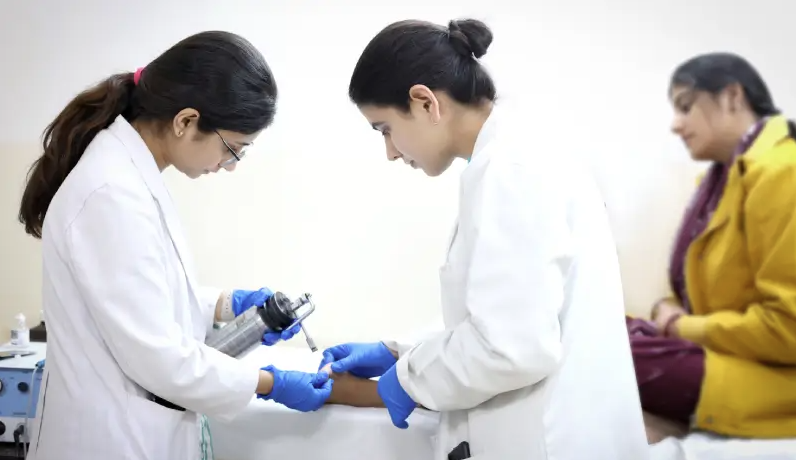
Per the department's own description, it functions as a centre for diagnosing and treating skin, hair, and nail conditions across all age groups, with training covering skin biopsies, UV therapy, mole removal, injection-based procedures, cosmetic treatments, and skin cancer detection. Graduates typically move into roles as clinical dermatologists, dermatology consultants, or academic faculty, per the university's own program page.
How to Become a Skin Doctor: Key Skills You'll Need
Beyond the formal qualifications, practicing dermatologists need a specific mix of skills: sharp visual diagnostic ability, since much of dermatology relies on recognizing patterns in skin presentation; steady procedural hands for biopsies, excisions, and cosmetic treatments; and strong patient communication, particularly around chronic conditions.
Frequently Asked Questions
Is dermatology a good career option?
Yes, for the majority of practitioners. Mixed with a relatively low number of hours and high earning potential and diverse clinical and cosmetic work, but extremely competitive to get into via NEET-PG.
How long does it take to become a dermatologist in India?
The time duration is approximately 8 to 9 years after 12th grade, i.e., 5.5 years of MBBS and 3 years of MD in dermatology, plus preparation time for NEET-UG and NEET-PG.
What job opportunities are available for dermatologists?
Dermatologists have opportunities in hospital dermatology departments and in government health services, private clinics, dedicated cosmetology and aesthetic practices, pharmaceutical and cosmetic research, and medical college academic and teaching positions.