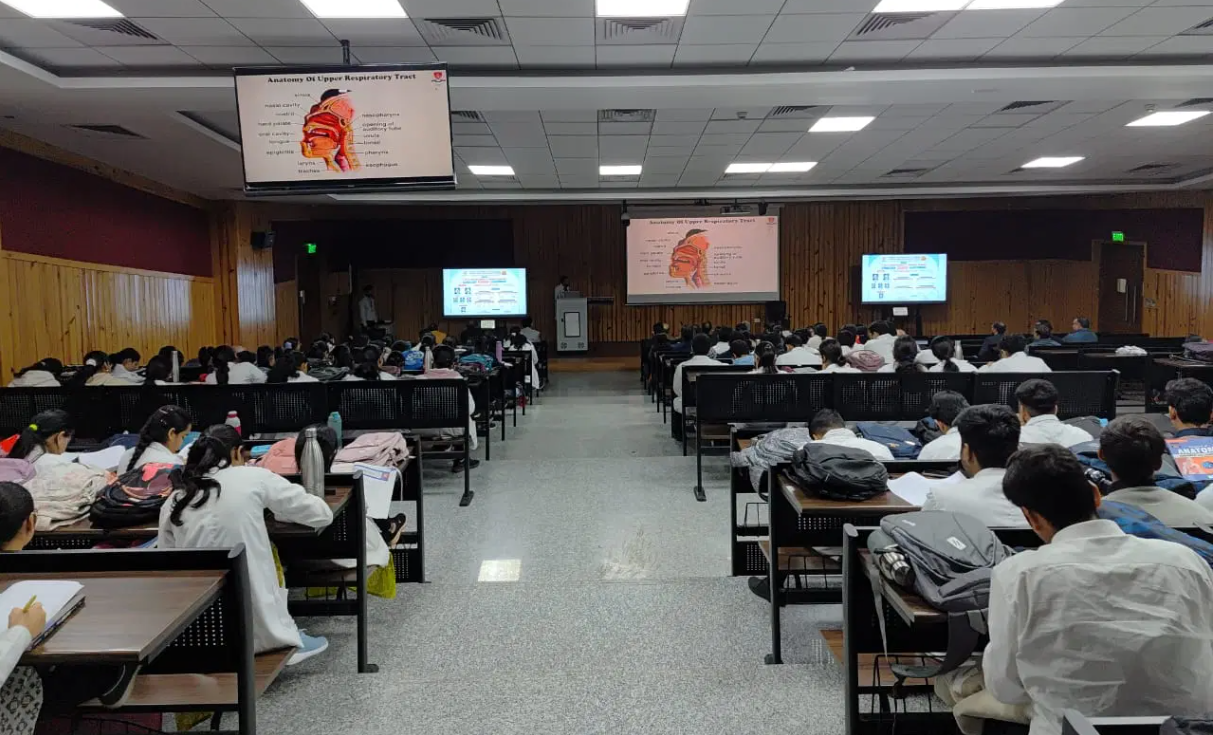
Medical education in the top medical colleges in Rajasthan isn't just about drug tables or anatomy charts. It deeply involves students in patient behavior, professional thinking, and the complex skill of making decisions when there is no time to lose. Every day, students deal with real people's lives and learn to listen to, watch, and react to them with care and precision. As students do research, which urges them to be curious, try new things, and come up with new ideas, ethics is always there to tell them that information has moral weight.
Specializations teach students more advanced information, which gives them the courage to work in complicated areas of medicine like public health, neuroscience, or heart. From training classrooms to telemedicine, technology is a part of learning. It helps ‘would-be’ doctors improve their skills and get ready for a healthcare world where digital is the first choice.
Research and Innovation in the Realm of Medical Education
Medical education in the best
medical colleges in Rajasthan is based on research, which helps students learn by doing clinical studies, exploring labs, and using evidence-based practice. In controlled study settings that are morally ruled, students try theories, look at results, and improve methods.
By coming up with new ideas, students make a big difference in the progress of medicine beyond just common findings and standard ways of treating illnesses. These additions make healthcare systems better by increasing precision, safety, and efficiency in a range of professional situations. Because of this, medical education becomes a real-time lab where progress is driven by interest and finding is guided by duty. This way of doing things trains doctors to make careful new inventions that help medicine while still respecting ethics, proof, and people's trust.
Soft Skills and Ethics Training
●
Clear patient communication skills
●
Empathetic listening and response
●
Compassionate bedside manners
●
Ethical decision-making practices
●
Legal awareness in healthcare
●
Informed consent understanding
●
Respecting patient confidentiality
●
Collaborative healthcare teamwork
●
Leadership in clinical settings
●
Effective patient counselling skills
●
Conflict resolution abilities
●
Professional responsibility and integrity.
Technology and Digital Health in Medical Education
Medical education in the top medical colleges in Rajasthan uses a lot of new technologies, which have changed the way people learn and get ready to work with patients. AI improves medical training by making pattern detection and predictive clinical logic more effective. Simulation rooms make real medical situations happen so that students can practice properly, over and over again.
Telemedicine experience teaches how to deal with patients virtually while keeping accuracy, kindness, and professional responsibility in mind. Digital tools are used alongside traditional teaching in order to find a balance between new ideas and basic medical knowledge. Students easily learn how to understand data, keep digital records, and use technology in healthcare processes.
This combination makes flexibility stronger, making sure that grads can deal with changes in the field of medicine. Digital learning tools encourage people to keep using them, work together, and learn new skills on their own. Because of this, technology makes it possible for medical students to learn outside of hospitals, classes, and texts.
Public Health, Community Work, and Lifelong Learning
●
Rural healthcare exposure programs
●
Understanding community health needs
●
Preventive medicine practice emphasis
●
Health awareness campaign participation
●
Public health policy understanding
●
Grassroots medical service experience
●
Community oriented medical approach
●
Social responsibility in healthcare
●
Population health management skills
●
Continuous medical education importance
●
Lifelong professional skill enhancement
●
Staying updated with advancements.
Concluding Remarks
MBBS is a good start, but the top medical colleges in Rajasthan also teach students about ethics, technology, service, and humanity. This journey shapes doctors by doing study, working with the community, using technology to improve healthcare, and practicing medicine with kindness and a focus on patients. Tests are a measure of information, but events build up a person's ability to make decisions, be resilient, stay curious, lead, and take social responsibility all the time.
When students learn outside of the classroom, their assigned tasks and other expected academic steps, they grow. They improve their skills by challenging what they think is true, using evidence to support their claims, working together with others, and accepting feedback with grace. In institutions like Mahatma Gandhi University of Medical Sciences and Technology (MGUMST), medical education emphasizes that the ability to be persistent, adaptable, and curious for life is much more important than doing well on tests. Every step allows us to grow as technology changes, cultures shift, new diseases come up, and demands keep rising. This long journey to becoming a doctor should be seen as a good thing by people who want to be doctors.